Money Graph — «Кто выше?»
Воспроизводимый AML-пайплайн: по 81 seed и четырёхшаговой выборке переводов присваивает роли всем 2 248 клиентам, строит кластеры, ранжирует очередь…
О проекте
Команда: Tenge Agents
Кейс HackAlem.ai: Финансы — Freedom
Стадия: Рабочий MVP
Задача кейса: «Граф денег»: восстановить структуру организованной группы по сети транзакций (AML)
Суть
Воспроизводимый AML-пайплайн: по 81 seed и четырёхшаговой выборке переводов присваивает роли всем 2 248 клиентам, строит кластеры, ранжирует очередь проверки и выдаёт автономный HTML-вьюер сети.
Как устроено
run.py загружает и сверяет три parquet, строит ориентированный взвешенный граф NetworkX, считает признаки и применяет упорядоченные прозрачные правила ролей (coordinator, distributor, consolidator, transit, terminal, peripheral) с порогами. Кластеры — Louvain (seed 42) на неориентированной проекции, взвешенной суммой KZT. Priority — взвешенная сумма активности, степени контрагента, прямых seed-плательщиков, силы роли и числа seed в кластере с понижающими множителями для seed и узлов глубины 4. Результат — 3 CSV и self-contained viewer.html.
Ключевые решения
- NetworkX
- Louvain
- правила ролей с порогами
- взвешенный priority score
- детерминированный вывод
Метрики
пайплайн ~0.2 с (2–3 с в чистом окружении); 91 кластер; роли: 5 coordinator, 39 consolidator, 61 distributor, 38 transit, 306 terminal, 1799 peripheral
Особенности
Байт-в-байт воспроизводимые выходы (сортировка по gid, канонические ID кластеров); gid хранятся строками во вьюере из-за выхода 18-значных ID за safe integer JS; подробные оговорки об ограничениях выборки (terminal ≠ деньги осели); без LLM и внешних сервисов.
Стек
Python · pandas · PyArrow · NetworkX · NumPy · HTML
Проект создан за 5 часов на финале хакатона HackAlem.ai (23 сентября 2026, Астана). Код — BAITC-Hacks/hack-4d800add-tenge-agents.
README
README.mdMoney Graph — «Кто выше?»
HackAlem AI 2026 · Finance track · Tenge Agents team
An AML analyst starts with 81 known seed clients and an outgoing-only, four-hop transfer sample. Money Graph produces a ranked investigation queue, numeric role evidence for every observed client, cluster summaries, and a searchable directed network view. Roles are hypotheses for review, not findings of guilt.
Run from this repository
Python 3.10–3.12 is required; the pinned dependencies do not support Python
3.13 or newer without compilation or version changes. The official organizer
input files are in data/ in this repository for hackathon judging only.
python3 -m venv .venv
. .venv/bin/activate
python3 -m pip install -r requirements.txt
python3 run.py --data data --out results
The last line is the one-command pipeline: it reads all three raw Parquet files, checks their consistency, and writes:
| File | Result |
|---|---|
results/nodes_roles.csv | 2,248 gids with role, 0–1 rule strength, cluster, 0–1 priority, and numeric evidence |
results/clusters.csv | 91 clusters with size, seed count, internal observed KZT, top gids, and hypothesis |
results/top_nodes.csv | 30 ranked gids with numeric reasons |
results/viewer.html | Self-contained searchable local viewer |
With the provided data, the expected first result is gid
100000004015047100, role consolidator, priority approximately 0.820.
Open results/viewer.html in a browser; it needs no server, account, network,
API key, or LLM. Search an exact gid, or click a top-list entry. The map shows
one-hop incoming and outgoing links with arrows, role colors, cluster context,
and clickable neighbors. Gids are encoded as strings in the viewer because
the 18-digit IDs exceed JavaScript's safe integer range.
For a judge walkthrough: run the command, open the viewer, inspect the top
candidate, then search any requested gid. The evidence text, metrics, incoming
and outgoing links, and visibility caveats are shown together. To check the
output contract and repeatability:
python3 -m unittest discover -s tests -v
Technology and configuration
The solution uses Python, pandas, PyArrow, NetworkX, and NumPy with the exact
versions in requirements.txt. It requires no environment variables, API
keys, external services, JavaScript packages, or build step.
On the provided dataset the pipeline completed in about 0.2 seconds in the development environment and approximately 2–3 seconds in a fresh virtual environment from a clean remote clone, below the five-minute limit. Observed role counts: 5 coordinator, 39 consolidator, 61 distributor, 38 transit, 306 terminal, 1,799 peripheral. Every role and priority number is a deterministic heuristic, not a trained or calibrated probability.
How decisions are made
All criteria use only observed graph attributes. Rules run in the order below;
the first match becomes the primary role. Full formulas and rationale are in
the methodology, with named thresholds in run.py.
| Role | Required observed evidence |
|---|---|
| coordinator | Non-seed; at least 2 direct seed payers, 3 total payers, and 2 recipients |
| distributor | At least 10 recipients; for non-seeds, also at least twice as many recipients as observed payers |
| consolidator | Non-seed below depth 4; at least 3 payers and 500,000 KZT in, with at most 20% observed onward |
| transit | Non-seed; observed in and out, at least 50,000 KZT in, outgoing/incoming ratio 0.80–1.20 |
| terminal | Non-seed at depth 1–3; at least 100,000 KZT in and no qualifying observed outflow |
| peripheral | No stronger rule, or insufficient outgoing visibility at depth 4 |
role_score measures how strongly the node meets its rule. It is not a
probability that the role is true. The word terminal means only that no
qualifying outflow was observed within the sampled network; it never proves
funds stayed there. Depth-four no-outflow nodes are peripheral with an
explicit boundary caveat.
Clusters use NetworkX Louvain with seed 42 on an undirected projection weighted
by observed KZT. Reciprocal transfers are summed before clustering. Direction
is retained for roles, ranking evidence, and the viewer. All 19 isolated seeds
become singleton clusters. Sorting by gid and canonical cluster IDs make
repeated outputs byte-identical in the checked environment.
Priority combines normalized observed in+out activity (30%), maximum
counterparty degree (20%), direct seed payers (20%), role strength (20%), and
cluster seed count (10%). Known seeds receive a ×0.50 factor because they are
already in the analyst's starting list. Depth-four no-outflow nodes receive a
×0.60 factor for limited visibility. top_nodes.csv gives concrete counts and
the two largest score contributions for each rank. These weights guide review;
they are not calibrated risk probabilities.
Input and limits
The organizer package contains 2,248 nodes, 3,119 directed aggregated edges,
and 4,840 transactions from July 2026. Collection starts at 81 seeds and
follows outgoing transfers for four hops, within one bank, for transfers
of at least 5,000 KZT. No names, demographics, balances, or external sources
are used. The three Parquet files under data/ are restricted to hackathon use.
The graph is incomplete by design: seed inflows and other outside-sample inflows are missing, and transfers beyond depth four are unobserved. Therefore observed in/out amounts are not account balances, a near-one ratio does not prove that the same money was forwarded, and a missing outflow does not prove money settled. Transactions below 5,000 KZT, other banks, and other dates are outside the sample. There are no verified role labels against which to measure accuracy.
The input graph has 35 weak components when all 19 isolated seeds are
included; the organizer's stated 16 counts only edge-containing components.
Louvain discards flow direction for grouping and may produce different
communities under a different NetworkX version. The pinned dependency versions
are in requirements.txt; use the checked environment for exact CSV comparison.
Architecture and scaling
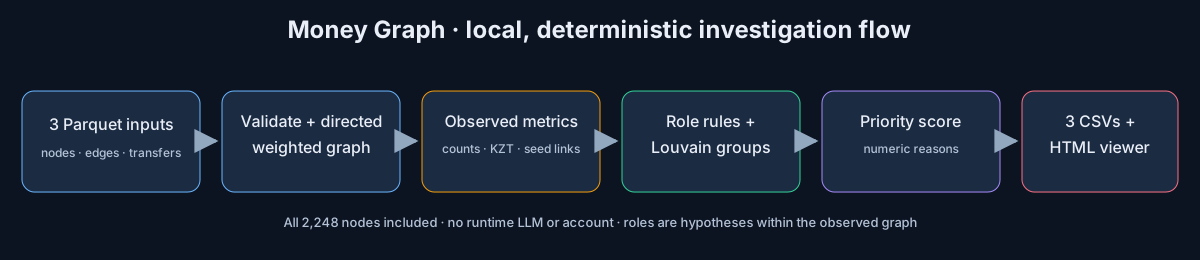
run.py loads and reconciles data, builds a directed weighted NetworkX graph,
calculates observed features, applies transparent role rules, clusters an
undirected projection, calculates priority, then writes CSVs and a standalone
HTML view. The viewer embeds precomputed facts and does not modify results.
At about one million nodes, replace NetworkX with a faster graph engine and columnar feature calculations, approximate expensive community/centrality work, store precomputed clusters and ego neighborhoods, and render only a searched neighborhood rather than the whole graph. The explainable batch role rules can remain, but their thresholds would need re-profiling on new data.
See disclosure for organizer materials and AI development assistance. No runtime LLM, paid service, or personal account is required.
Авторы коммитов
История коммитов
- 2026-09-23 17:02fix docs: agents.md, readme.md and other docsredocebiv
- 2026-09-23 16:08readme file updateredocebiv
- 2026-09-23 15:48docs: record clean clone and hackathon submissionredocebiv
- 2026-09-23 15:44fix: keep viewer search visible while scrollingredocebiv
- 2026-09-23 15:41fix: clarify evidence and directed viewer displayredocebiv
- 2026-09-23 15:32docs: move public guidance to root and ignore docs directoryredocebiv
- 2026-09-23 15:30feat: runnable money graph pipeline and viewerredocebiv
- 2026-09-23 14:55project docs, requirements.txt, env example, readme updateredocebiv
Все коммиты (12)
- 2026-09-23 14:36update repo structure, upd gitignoreredocebiv
- 2026-09-23 14:13update gitignoreredocebiv
- 2026-09-23 13:54docs: define project scope and progressredocebiv
- 2026-09-23 13:09first commit, gitignoreredocebiv
Структура репозитория (23 файлов)
.gitignore
AGENTS.md
ARCHITECTURE.md
DISCLOSURE.md
METHODOLOGY.md
README.md
REQUIREMENTS.md
STATUS.md
VERIFICATION.md
data/README.md
data/edges.parquet
data/nodes.parquet
data/transactions.parquet
pytest.ini
requirements.txt
results/clusters.csv
results/nodes_roles.csv
results/top_nodes.csv
results/viewer.html
run.py
solution.svg
tests/test_pipeline.py
viewer/index.html
Обсуждение 0 комментариев
Войдите, чтобы комментироватьПока нет комментариев — будьте первым.