О проекте
Команда: 404
Кейс HackAlem.ai: Коммуникации — Halyk Bank · кейс 2
Стадия: Доведённый продукт
Задача кейса: «Voice Router»: голосовой AI, маршрутизирующий звонки в контакт-центре страховой компании
Суть
Голосовой ассистент контакт-центра страховой: Gemini Live слушает и говорит на русском и казахском, LLM маршрутизирует запрос по 40 официальным сценариям, выполняет действия над демо-данными с подтверждением и показывает супервизору трассу решения.
Как устроено
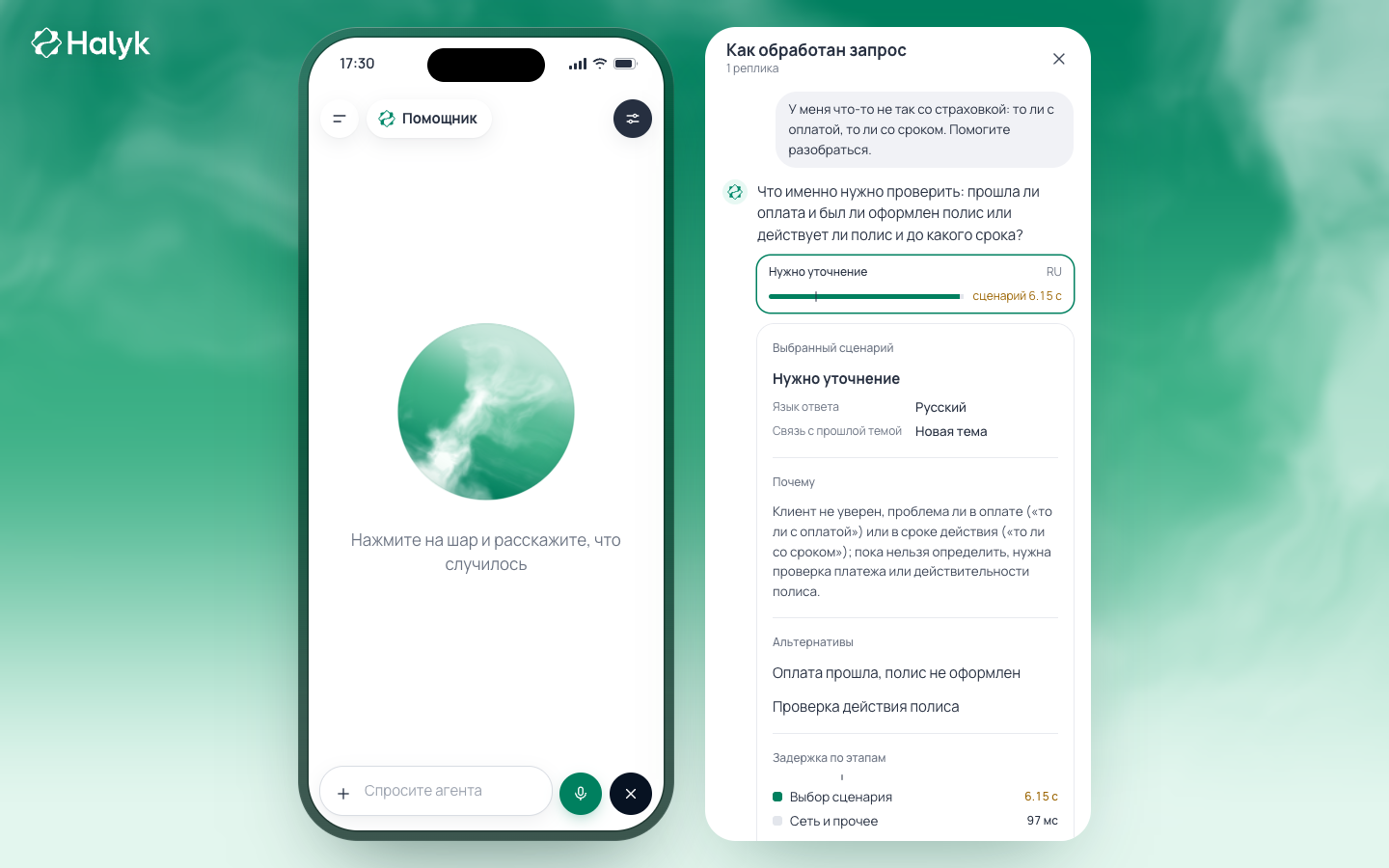
Браузер получает краткоживущий токен Gemini Live для потокового распознавания, синтеза речи и перебиваний. Backend voice_router маршрутизирует реплику через OpenAI gpt-6-luna по каталогу из 40 сценариев стартового набора, извлекает слоты и ведёт диалог с контекстом до 10 реплик. При неоднозначности задаёт уточняющий вопрос, для чувствительных действий требует подтверждения, готовит handoff-запись для оператора. Ответы опираются на knowledge_base и mock_backend. Трасса содержит транскрипт, сценарий, причину, альтернативы и тайминги этапов.
Ключевые решения
- LLM-маршрутизация по каталогу сценариев
- multi-intent
- slot extraction
- уточнение при неоднозначности
- confirmation для чувствительных действий
- ephemeral tokens
- latency trace
Метрики
Dev-набор: 104/104 точных маршрута; real-voice: 11/11 записей
Особенности
Голос (Gemini Live) и принятие решения (LLM-роутер на backend) разделены, факты для ответа отдаёт backend. Супервизор видит альтернативы и тайминги каждого этапа. Эксперименты по выбору модели и проверке на реальном голосе задокументированы, есть развернутое демо с HTTPS.
Стек
Python 3.12 · uv · React · TypeScript · Vite · Docker · Docker Compose
Модели
Gemini Live · gpt-6-luna
Проект создан за 5 часов на финале хакатона HackAlem.ai (23 сентября 2026, Астана). Код — BAITC-Hacks/hack-93b60efd-404.
README
README.mdSaqta Voice
[!IMPORTANT] You can see how Saqta Voice works in the live demo below. The app and API are already deployed; no local setup is needed.
Open the demo: Saqta Voice
Demo URL: https://hackalem-137-74-166-29.sslip.io/
Guest login:
hackalemGuest password:
[скрыто]
Voice support that follows the conversation.
A customer rarely speaks in neat menu options. They explain a problem in their own words, remember a second question halfway through, or switch from Russian to Kazakh. Saqta Voice is a web-based insurance assistant built for that conversation: it listens, chooses a service scenario, responds aloud, and shows a supervisor why it made that choice.
Built by Team 404 for HackAlem AI · Halyk Bank · Case 2: Voice Router. Saqta Insurance and its customer records are fictional materials supplied for the challenge; this app is not connected to real Halyk Bank accounts.
The problem
Traditional voice menus make the customer translate a real problem into one of a few prepared phrases. That breaks down when a request sits between two topics, the customer changes their mind, or both languages appear in the same conversation. A wrong turn means repeating the story or waiting for a person.
Saqta Voice moves the decision from a fixed phrase classifier to a language-model routing layer. The assistant can handle natural speech while a supervisor sees the selected scenario, other possibilities, the reason, and how long each stage took. The important result is not just a pleasant voice; it is a better decision about what the customer needs.
Try the main flow
Use the temporary guest login above; it is not an OpenAI or Gemini API key.
Allow microphone access and speak in Russian or Kazakh. Text input is available as a secondary path. A useful first request is: “Я оплатил полис, но он не активен. Что мне делать?” Then ask a follow-up or change topic. Open Как обработан запрос to see the transcript, chosen scenario, explanation, alternatives, and stage timings. The sidebar includes a supervisor view for reviewing routing decisions.
The URL has a valid HTTPS certificate. We verified the public page, authentication boundary, a real text-to-routing-to-answer flow, and creation of a Gemini voice-session token on the hosted server.
What the product does
Gemini Live handles streaming microphone input, spoken responses, language switching, and interruption. Insurance requests go to an OpenAI gpt-6-luna routing layer that compares the conversation with the 40 original scenarios in the official starter kit. The backend uses the supplied company knowledge and sample records for business answers. A backend session retains up to ten customer turns.
When the request is ambiguous, the assistant asks a natural clarifying question instead of reciting internal scenario names. When a customer changes topic, the routing layer can switch while retaining context. Sensitive changes require a separate interpreted confirmation turn. If the assistant cannot resolve a request, it can prepare a local handoff record; this prototype does not connect a live operator.
The trace is visible after each routed turn: transcript, human-readable scenario, reason, alternatives, and measured processing stages. Technical IDs remain available in the API but are not shown in the ordinary interface.
Run locally
You need Python 3.12, uv, Node.js 20+, npm, and server-side OPENAI_API_KEY and GEMINI_API_KEY. Provide the keys through your shell or a secret manager; do not add them to frontend/.env or commit them to Git.
From the repository root:
bash scripts/run-local.sh
Open http://localhost:5173 and allow microphone access. The command installs the locked local dependencies and starts both the API and web app. If a provider is unavailable, the app reports the failure; it does not silently switch to a prerecorded conversation.
For the hosted build, the tracked Dockerfile and Compose service run a Git-SHA-tagged image behind HTTPS. Provider keys and VOICE_ROUTER_BASIC_AUTH are set only in the server runtime environment; no container port is published directly. The login above is a temporary shared demo credential and should be changed after review.
How it works
Customer voice → Gemini Live (listening and speech)
               → Voice Router API → OpenAI routing across 40 scenarios
                                  → starter-kit facts and case actions
               → spoken answer + supervisor trace
The backend owns scenario selection and business facts; Gemini speaks the returned answer naturally. Case actions use the organizer's synthetic data. Irreversible changes require explicit confirmation. The browser receives only a short-lived Gemini session token; the provider API keys remain server-side.
The HTTP contract describes the API. The Russian functional plan explains decision boundaries. Source code lives in backend/voice_router and frontend; the organizer's starter kit is preserved in data/voice_router_dataset.
Reviewer map
This map points to evidence for the official evaluation criteria; the weights are the rubric, not a self-awarded score.
| Criterion | Where to verify it |
|---|---|
| Working solution · 25 | Hosted app, 40 official scenarios, and voice interaction |
| Technical implementation · 25 | LLM routing, dialogue and confirmations, case actions, and human-readable trace |
| README and reproducibility · 25 | Guest access above, one-command local launch, HTTP contract, and deployment files |
| Value and applicability · 15 | The customer problem and supervisor workflow above; answers use the organizer's synthetic knowledge base |
| Potential and originality · 10 | Multi-intent context, ambiguity review, RU/KZ speech, and the measured routing and real-voice results |
What has been checked
The official development set contains 104 labeled utterances. The selected router returned the exact ordered route for 104/104 in the recorded development run. That set informed development, so this is not an estimate of accuracy on the jury's hidden ten utterances. A separate real-voice check routed 11/11 scorable recordings from two team members as expected. The Luna/Sol comparison records the model choice and measured latency.
You can re-run the organizer's evaluator on the recorded development predictions without a paid API call:
uv run python data/voice_router_dataset/evaluate.py \
  docs/experiments/results/luna-dev-predictions.json \
  data/voice_router_dataset/dev_utterances.json
The hosted text path was checked through the actual HTTPS page and API. The routing experiment and real-voice experiment record the measured stages and their test conditions.
What we would build next
Five hours is enough to prove the product direction, not to finish every contact-center integration. The clearest next win is speed. We would test Jev as a fast typed decision layer for narrow, low-risk checks such as whether a second ambiguity review or slot-extraction pass is needed, while keeping the language model responsible for selecting the business scenario. In parallel, we would shorten the routing context and overlap independent work with the streaming voice session. Our engineering target is 1–2 seconds for common requests without losing Russian/Kazakh or multi-intent accuracy; this remains a target for a measured experiment.
We would then add precise end-of-speech-to-first-audio measurement in the browser, a persistent case history, a real operator handoff carrying the conversation context, and an editor for the scenario catalog. Each change has a clear acceptance check: compare accuracy and p50/p95 latency on new speech, verify the operator receives the right context, and require confirmation before any real-world change. The current product already exposes the trace needed to make those improvements measurable.
Data, safety, and scope
The 40 scenarios, company facts, and sample customer records come from the official HackAlem starter kit. They are synthetic. OpenAI and Gemini are external AI services; no real customer recordings or bank data are used here.
This is a contest prototype, not a live contact center. Actions affect only in-process sample records; it does not charge cards, send SMS, book a real clinic, or connect a live operator. Sessions reset when the server restarts. Real customer use would need production authentication, privacy controls, persistent case history, rate limiting, and operator integration.
Why this can extend beyond the challenge
The routing layer reads a scenario catalog instead of hard-coded test phrases. A future team could replace the fictional catalog and sample actions with approved products, knowledge, and service integrations while retaining the voice and supervisor experience. That migration would require a fresh accuracy, latency, security, and human-handoff evaluation.
Sources and third-party components
- HackAlem Case 2 technical specification, official starter kit, and regulations
- React and Vite (MIT), Google Gen AI SDK and OpenAI Python SDK (Apache-2.0), and Pydantic (MIT) are third-party components. These license identifiers were checked against the installed package metadata.
frontend/package-lock.jsonanduv.lockrecord the local dependency resolution; hosted Python packages are built from the ranges inpyproject.toml. Model use is governed by each provider's service terms.
Team 404 built the contest-specific routing, dialogue, actions, API, and web experience in the official repository. Organizer data and third-party components are identified above rather than presented as team-created assets.
Авторы коммитов
История коммитов
- 2026-09-23 17:58docs(submission): focus reviewer copy on verified evidencealtyshalu
- 2026-09-23 17:53fix(ui): show text replies in chatNikita Nosov
- 2026-09-23 17:51docs(review): map rubric to evidencealtyshalu
- 2026-09-23 17:46docs(readme): soften live demo invitationNikita Nosov
- 2026-09-23 17:44docs(readme): make demo access unmistakablealtyshalu
- 2026-09-23 17:42docs(readme): lead with hosted demoNikita Nosov
- 2026-09-23 17:37docs(readme): identify third-party licensesaltyshalu
- 2026-09-23 17:34docs(readme): report observed hosted latencyNikita Nosov
Все коммиты (65)
- 2026-09-23 17:33docs(readme): present hosted Saqta Voice productaltyshalu
- 2026-09-23 17:29fix(ui): name all scenarios in RussianNikita Nosov
- 2026-09-23 17:27fix(ui): localize system routes in tracealtyshalu
- 2026-09-23 17:26fix(dialogue): ask natural clarification questionsNikita Nosov
- 2026-09-23 17:21fix(build): locate catalogue in installed imagealtyshalu
- 2026-09-23 17:19build(deploy): define isolated OVH serviceNikita Nosov
- 2026-09-23 17:15fix(build): use dedicated container useraltyshalu
- 2026-09-23 17:14fix(api): restore reliable routing and secure servingNikita Nosov
- 2026-09-23 17:14fix(ui): simplify voice assistant presentationaltyshalu
- 2026-09-23 16:58fix(voice): reject fake microphone inputsNikita Nosov
- 2026-09-23 16:51feat(voice): integrate Gemini Live and Jev slot gateNikita Nosov
- 2026-09-23 15:53feat(api): expose scenario metadata for tracesaltyshalu
- 2026-09-23 15:53revert(ui): restore the side slide for the trace panelErnis
- 2026-09-23 15:51feat(router): verify ambiguous decisionsNikita Nosov
- 2026-09-23 15:49feat(ui): slide the trace panel out from under the phoneErnis
- 2026-09-23 15:46revert(ui): restore the side slide for the trace panelErnis
- 2026-09-23 15:41feat(appointments): validate DMS clinic requestsaltyshalu
- 2026-09-23 15:38feat(dialogue): preserve concurrent customer intentsNikita Nosov
- 2026-09-23 15:38fix(ui): tuck the trace panel fully behind the phoneErnis
- 2026-09-23 15:34feat(ui): slide the trace panel out from under the phoneErnis
- 2026-09-23 15:32feat(case-data): retain local policy statealtyshalu
- 2026-09-23 15:31feat(handoff): apply official escalation rulesNikita Nosov
- 2026-09-23 15:28style(ui): make the bezel emerald smoked glassErnis
- 2026-09-23 15:27feat(handoff): preserve operator contextaltyshalu
- 2026-09-23 15:26style(ui): use a dark translucent phone bezelErnis
- 2026-09-23 15:25feat(workflows): complete quoted case transitionsNikita Nosov
- 2026-09-23 15:23fix(ui): smooth the menu drawer and prevent a white orb flashErnis
- 2026-09-23 15:21refactor(ui): say agent instead of robotErnis
- 2026-09-23 15:20feat(ui): animate opening and closing the trace panelErnis
- 2026-09-23 15:19feat(responses): ground spoken answers in case factsaltyshalu
- 2026-09-23 15:19refactor(ui): remove the demo badge from the headerErnis
- 2026-09-23 15:17docs: specify voice backend contractNikita Nosov
- 2026-09-23 15:17style(ui): tighten typography and calm the surrounding UIErnis
- 2026-09-23 15:16feat(voice): serve spoken case turnsaltyshalu
- 2026-09-23 15:15feat(dialogue): run contextual case workflowsNikita Nosov
- 2026-09-23 15:10feat(actions): execute official case operationsaltyshalu
- 2026-09-23 15:10style(ui): reserve green for brand and routingErnis
- 2026-09-23 14:57fix(ui): restore a visible but smooth orb pulseErnis
- 2026-09-23 14:53fix(ui): smooth the orb reaction to microphone levelErnis
- 2026-09-23 14:51perf(router): reduce unclear route errorsNikita Nosov
- 2026-09-23 14:50style(ui): use Halyk green for the microphone buttonErnis
- 2026-09-23 14:49feat(ui): adapt the layout for mobile and keep routing chips in the traceErnis
- 2026-09-23 14:31refactor: rename web/ to frontend/Ernis
- 2026-09-23 14:18feat(router): add catalogue-backed LLM routingNikita Nosov
- 2026-09-23 14:11docs: remove the Russian README and document the trace feedErnis
- 2026-09-23 14:10feat(trace): show turns as an expandable conversation feedErnis
- 2026-09-23 14:10feat(catalog): import and validate case dataaltyshalu
- 2026-09-23 14:09docs: define backend scope and delivery planaltyshalu
- 2026-09-23 14:05docs: rewrite the README in EnglishErnis
- 2026-09-23 14:03feat(ui): add the Halyk logo across the interfaceErnis
- 2026-09-23 13:57feat(ui): reskin the interface to the Halyk brandErnis
- 2026-09-23 13:54docs: plan Voice Router implementationNikita Nosov
- 2026-09-23 13:49style(ui): flatten the phone bezelErnis
- 2026-09-23 13:47style(ui): add a frosted translucent phone bezelErnis
- 2026-09-23 13:45feat(ui): frame the app in a phone over a WebGL cloud skyErnis
- 2026-09-23 13:38feat(ui): add voice mode with a reactive orbErnis
- 2026-09-23 13:32feat(ui): add ChatGPT-style web interface with trace and supervisorErnis
Структура репозитория (67 файлов)
.dockerignore
.gitignore
.python-version
Dockerfile
README.md
backend/voice_router/__init__.py
backend/voice_router/actions.py
backend/voice_router/catalog.py
backend/voice_router/dialogue.py
backend/voice_router/evaluate_router.py
backend/voice_router/evaluate_voice.py
backend/voice_router/router.py
backend/voice_router/server.py
backend/voice_router/slots.py
data/README.md
data/voice_router_dataset/README.kz.md
data/voice_router_dataset/README.md
data/voice_router_dataset/README.ru.md
data/voice_router_dataset/actions.json
data/voice_router_dataset/dev_utterances.json
data/voice_router_dataset/dialogs_sample.json
data/voice_router_dataset/evaluate.py
data/voice_router_dataset/knowledge_base.json
data/voice_router_dataset/mock_backend.json
data/voice_router_dataset/scenarios.json
data/voice_router_dataset/slots.json
deploy/compose.yml
docs/BACKEND_API.md
docs/VOICE_ROUTER_PLAN_RU.md
docs/experiments/2026-09-23-luna-sol-routing.md
docs/experiments/2026-09-23-real-voice.md
docs/experiments/README.md
docs/experiments/TEMPLATE.md
docs/experiments/results/luna-dev-predictions.json
docs/images/saqta-voice.png
frontend/.env.example
frontend/.gitignore
frontend/index.html
frontend/package-lock.json
frontend/package.json
frontend/src/App.tsx
frontend/src/api/client.ts
frontend/src/api/types.ts
frontend/src/components/Chat.tsx
frontend/src/components/CloudCanvas.tsx
frontend/src/components/Composer.tsx
frontend/src/components/LatencyBar.tsx
frontend/src/components/PhoneFrame.tsx
frontend/src/components/RouteChip.tsx
frontend/src/components/Sidebar.tsx
frontend/src/components/Supervisor.tsx
frontend/src/components/TracePanel.tsx
frontend/src/components/VoiceOrb.tsx
frontend/src/components/icons.tsx
frontend/src/lib/format.ts
frontend/src/main.tsx
frontend/src/state/types.ts
frontend/src/state/useConversations.ts
frontend/src/styles.css
frontend/src/vite-env.d.ts
frontend/src/voice/tts.ts
frontend/src/voice/useGeminiLive.ts
frontend/tsconfig.json
frontend/vite.config.ts
pyproject.toml
scripts/run-local.sh
uv.lock
Обсуждение 0 комментариев
Войдите, чтобы комментироватьПока нет комментариев — будьте первым.